
Click on the Button to see Spectrum Yearly Activity
600-700 MHz
2015
2014
2013
2012
2011
2010
2009
698-806 MHz
2015
2014
2013
2012
2011
2010
2009
2.4-2.5 GHz
2015
2014
2013
2012
4.940-4.990 GHz
2015
2014
2013
2012
2011
2010
2009
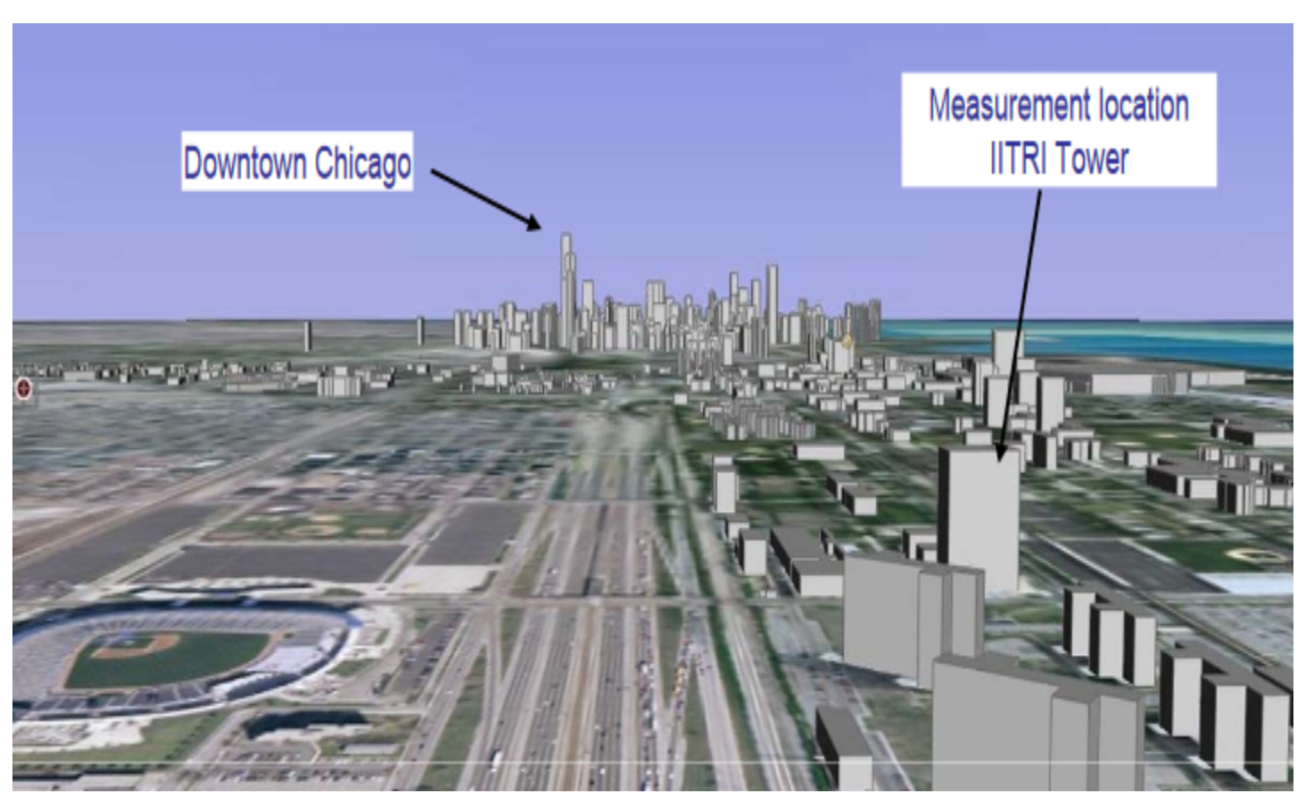
The measurements were made at the Illinois Institute of Technology (IIT), Chicago, Illinois.The IIT Tower has an unobstructed view in all directions as shown in Figure. A detailed explanation of the site, measurement setup and data collection is listed in [1]. Several spectrum occupancy measurements were performed in Chicago and proposals for long-term studies in multiple locations have been made from the spectrum observatory in these papers [1-4]
I did this work when I was a Research Assistant at Wireless Network and Communications Research Center (WiNCom) from Jan 2016 – Aug 2017.
Objective: To study the utilization of the wireless spectrum, in order to come up with schemes for optimal usage through different models. To collect spectrum data from different sites and analyzing the data.
[1] McHenry, M.A., McCloskey, D., Roberson, D.A., MacDonald, J.T.: Spectrum Occupancy Measurements, Chicago, Illinois, November 16-18 2005. Technical report, Shared Spectrum Company Report (2005).
[2] M.A. McHenry, P.A. Tenhula, D. McCloskey, D.A. Roberson, and C.S. Hood, “Chicago Spectrum Occupancy Measurements & Analysis and a Long-term Stud- ies Proposal,’ in Proceedings of First International Workshop on Technology and Policy for Accessing Spectrum, TAPAS’06, Boston, MA, August 2006.
[3] J. T. MacDonald and D. A. Roberson, “Spectrum Occupancy Estimation in Wireless Channels with Asymmetric Transmitter Powers,” in 2nd International Conference on Cognitive Radio Oriented Wireless Networks and Communications, Orlando, FL, USA, 2007, pp. 245-249. doi: 10.1109/CROWNCOM.2007.4549804
[4] R. Singh, R. Peterson, A. Riaz, C. Hood, R. Bacchus, D. Roberson, “A method for evaluating coexistence of LTE and radar altimeters in the 4.2–4.4 GHz band”, Wireless Telecommunications Symposium (WTS), pp. 1-9, 2017. (link)